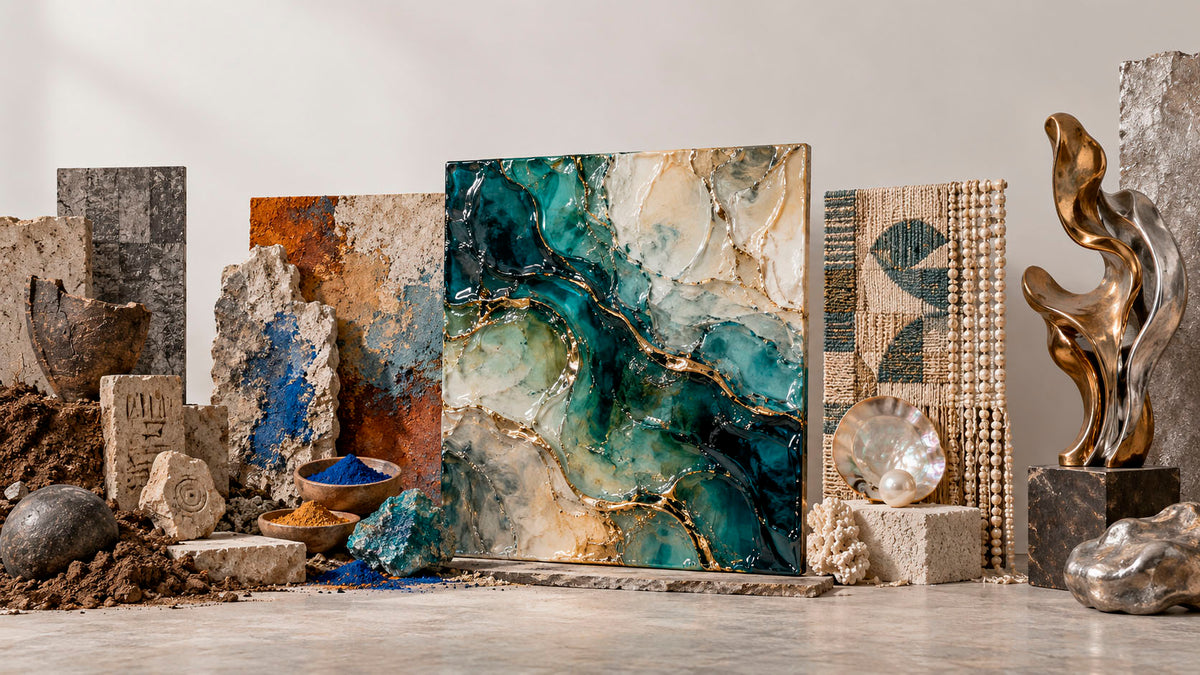
Collectors rarely discover an artist at the exact moment that artist becomes obvious. The more interesting window is earlier: when a practice already has a distinctive language, but its place in the wider art world is still being formed.
That is why searches for emerging contemporary artists, artists to watch and new artists to collect are useful — but also difficult. “Emerging” does not simply mean young, inexpensive or unknown. An artist can be in their thirties or forties, have years of serious work behind them, and still be entering a new level of institutional, critical or collector attention.
This list is not a ranking and it is not an investment forecast. It is an editorial watchlist built around five artists whose practices feel especially relevant in 2026 because they are doing more than producing a recognizable look. They are developing distinct systems of making: new relationships between pigment, sculpture, memory, geology, cultural inheritance and physical process.
For collectors and galleries looking for something genuinely new in contemporary art, that distinction matters. A fashionable image can be copied quickly. A convincing artistic language is much harder to replace.
What makes an emerging artist worth watching?
For this selection, we looked for five things:
- A specific visual or material language. The work should be identifiable for more than one fashionable surface effect.
- A coherent body of work. One impressive image is not enough; the ideas need to continue across multiple works.
- Evidence of momentum. Exhibitions, fair presentations, institutional commissions or serious gallery support can show that the practice is being tested outside the artist’s own circle.
- Room to develop. The most interesting emerging artists do not look finished. Their work suggests a direction that can still expand.
- Material or conceptual necessity. The process should feel connected to the meaning of the work rather than added simply to make it look unusual.
Those criteria produced a surprisingly coherent group. Although the five artists work very differently, all of them treat material as more than a neutral carrier for an image.
1. Abraham González Pacheco — archaeology for histories that never existed
Based in: Mexico
Why watch: archaeological fiction, landscape, concrete, soil and speculative history
Abraham González Pacheco creates work that behaves as though it has been excavated from a history that never quite happened. His drawings, installations and architectural interventions often begin with gaps in official narratives and turn those absences into what he has described through his practice as archaeological fictions.
At Frieze New York 2026, González Pacheco was one of the artists selected for the fair’s Focus section, which is dedicated to solo presentations by younger galleries and experimental practices. His works there incorporated materials including cactus sap, soil, pigments, graphite and charcoal. The material choice is important: the landscape is not merely represented in the image; part of the landscape physically enters the work.
His 2026 momentum extends well beyond an art-fair booth. The 59th Carnegie International commissioned Orogenic, a group of concrete, pigment and graphite works on metal structures. The project expands his archaeological logic to a monumental architectural scale, imagining artifacts for a speculative future.
What collectors and galleries may want to watch next: whether this language can continue moving between intimate works on paper and large institutional installations without becoming dependent on scale. The underlying idea — history as something unstable, material and reconstructable — has enough depth to support both.
2. Su Yu-Xin — painting as geology, trade and material history
Born: 1991, Hualien, Taiwan; based in Los Angeles
Why watch: handmade pigments, geology, landscape and the politics of colour
Su Yu-Xin makes paintings, but describing them only as paintings misses much of what makes the practice distinctive. She treats colour almost as a geological archive. Minerals, shells, soil, industrial compounds and other substances are collected, studied, processed and transformed into pigments that carry their own histories before they reach the surface.
Her 2026 works can contain materials such as volcanic rock, sea glass, lapis lazuli, oyster shells, cochineal, malachite, tourmaline, hematite, copper compounds and handmade pigments. In Afterstone, her 2026 exhibition with Albion Jeune in Venice, the process of grinding and recombining materials becomes inseparable from questions about landscape, extraction, trade and how colour itself moves through human history.
This is not material experimentation for novelty’s sake. Su’s practice asks what a landscape painting can be when the landscape is literally present as matter. The image and the substance that produces the image begin to collapse into one another.
Her trajectory already includes a 2025 solo exhibition at the Orange County Museum of Art, and her current practice sits in an interesting position: visibly institutional, yet still expanding rapidly in scale and material complexity.
What collectors and galleries may want to watch next: the way her pigment research develops into a durable artistic vocabulary. The strongest aspect of the practice is not simply that the ingredients are unusual; it is that the materials create a framework for thinking about migration, geology, extraction and the history of painting itself.
3. Olena Moloda — inventing a medium instead of inheriting one
Born in: Ukraine; based in Spain
Why watch: Moltenism, artist-developed transparent medium, controlled unpredictability and physical surface
Olena Moloda’s work enters this list from a different route. Rather than beginning with an established medium and pushing its imagery in a new direction, she developed a painting medium of her own and built an artistic language around its behaviour.
Moloda calls that language Moltenism. It is created on canvas using an artist-developed transparent painting medium capable of forming translucent layers, glossy surfaces, raised lines, pools of colour and areas of physical relief. Gravity, pressure, viscosity, timing and movement all influence the result.
That creates a productive tension between authorship and unpredictability. Moloda determines the composition, palette, direction and balance, but the material has its own physical behaviour. Two works can share a colour family or belong to the same series without producing identical flows, edges or internal structures.

The name Moltenism comes from the material’s visual association with molten or coloured glass, but the work is not glass and it is not a conventional resin-pour process. Its identity comes from the medium Moloda developed and the way she uses it as a repeatable artistic language rather than a single technical trick.
Moloda is also directly connected to MOLODA ART GALLERY in Las Palmas de Gran Canaria, so our relationship to her practice is explicit. We include her here because the same criterion applied to the other artists — material invention that produces a recognizable body of work — is central to her practice.
For collectors, that point is particularly interesting. When an artist’s identity is tied not only to subject matter or colour but to a self-developed physical process, the authorship is embedded in the object itself. A photograph can reproduce the composition of a Moltenism work, but not the changing reflection, transparency and relief of the original surface.
You can read more about why every original Moltenism painting develops differently or explore the Moltenism collection.
What collectors and galleries may want to watch next: how Moltenism develops from a distinctive technical language into a broader body of work across scale, series and exhibition contexts. The key question is not whether the surface is visually unusual; it is how far the material can continue generating new compositional and conceptual possibilities.
4. Charlene Tan — cultural memory reconstructed through pattern and matter
Born: 1982, Houston; based in San Francisco
Why watch: Filipino weaving traditions, pattern, shells, pearls and unexpected food materials
Charlene Tan’s work starts with pattern, but the real subject is transmission: how cultural forms survive, change and become personal when they move between generations and places.
Tan draws on weaving traditions from the Philippines, digitally scanning found patterns, reducing and restructuring them, then retracing them by hand. The works are subsequently built up with materials that can include pearls, abalone, capiz shells, rhinestones, ube powder and even thousands of small tapioca balls.
That unusual material vocabulary could easily become decorative spectacle, but its significance is rooted in biography and cultural memory. Tan has connected the work to childhood experiences in the Philippines, her grandmother’s work as a seamstress and embroiderer, and her own attempt to reinterpret inherited visual systems rather than simply reproduce them.
In 2026, Tan appeared in Artsy’s selection of five artists to follow at Foundations 2026, a showcase devoted to artists near the beginning of their careers. She also presented new work with re.riddle at NADA New York 2026.
What collectors and galleries may want to watch next: how far Tan can push the relationship between pattern, cultural inheritance and sculptural surface. The most compelling works are not simply “weaving-inspired”; they turn reproduction, handwork and material memory into a system that is recognizably her own.
5. Joanne Burke — letting molten wax decide the first move
Based in: Europe / United Kingdom gallery context
Why watch: lost-wax casting, bronze, aluminium and chance-driven sculptural form
Joanne Burke’s sculptures begin with a process that sounds almost too simple: molten wax is dispersed in water. The meeting between those two materials produces unpredictable forms, and those unstable wax structures become the basis for objects cast in bronze or aluminium.
The process is a useful reversal of traditional sculptural control. Bronze is historically associated with permanence, monumentality and deliberate form. Burke begins instead with a temporary event that cannot be fully designed in advance, then freezes that event into metal.
Frieze selected Burke among its five emerging artists to watch at Frieze New York 2026, where Soft Opening presented her work in the Focus section. Her gallery’s current programme also shows a continuing 2026 body of bronze and bronze-aluminium sculptures, including pieces such as Festival 8, Eve’s Compass and Starrchamber.
The attraction here is not merely the novelty of the wax-water process. The resulting forms hover between ornament, relic, biological fragment and artifact. They seem familiar without becoming fully identifiable.
What collectors and galleries may want to watch next: whether Burke’s chance-based vocabulary can keep producing formal surprise as the body of work expands. When process art becomes recognizable, the challenge is to avoid letting the method become predictable. Her recent work suggests that the tension between accident and metal permanence still has considerable room to develop.
What connects these five artists?
At first glance, very little. González Pacheco constructs speculative archaeology. Su Yu-Xin grinds geology into pigment. Olena Moloda builds paintings through a medium she developed herself. Charlene Tan translates inherited patterns through shells, pearls and food materials. Joanne Burke converts accidental wax forms into metal.
But the common thread is important: material intelligence.
For much of the digital era, “new art” has been discussed primarily through images, software, platforms and new distribution systems. Those remain important. But another direction is increasingly visible: artists are returning to the physical object with a much more complicated understanding of what material can carry.
Soil can carry history. Pigment can carry geology and trade. Wax can preserve an accident. A transparent painting medium can become an artist’s own syntax. A shell or food ingredient can carry family memory and cultural transmission.
For collectors, this matters because it creates a form of specificity that is difficult to flatten into a thumbnail. The work asks to be examined physically: from the side, at different distances, under different light and with attention to how it was made.
How should a collector approach an emerging artist?
The worst reason to buy an emerging artist is the promise that the work will “be worth more later.” No serious watchlist can guarantee that.
A more useful approach is to examine the practice itself:
- Can you recognize a coherent artistic language across multiple works?
- Does the artist’s process serve an idea, or is it only a visual gimmick?
- Is the work developing rather than simply repeating one successful formula?
- Is there independent evidence that curators, galleries, critics or institutions are engaging with the practice?
- Would the work still interest you if its market price never changed?
Those questions will not predict the market. They will help you distinguish a serious developing practice from a fashionable image.
For a deeper framework, read our guide to 10 signs an emerging artist may be building a strong career. Despite the older URL wording, the article itself does not promise future value; it focuses on coherence, documentation, independent visibility and professional development.
The most interesting “new art” may not look futuristic at all
One of the striking things about this group is that none of these practices depends on looking technologically futuristic. The newness is deeper than style.
It can be found in a pigment recipe, a casting event, an invented painting medium, a reinterpreted weaving structure or an imagined archaeological object. These artists are not necessarily abandoning the history of painting and sculpture. They are reopening it from inside the material.
That may be one of the more useful directions for collectors and galleries to watch in 2026: not simply what does new art look like?, but what new artistic systems are being built — and which artists have enough depth to keep developing them?
Sources and further reading
- Frieze — Five Emerging Artists to Watch at Frieze New York 2026
- Carnegie Museum of Art — Abraham González Pacheco, 59th Carnegie International
- Albion Jeune — Su Yu-Xin: Afterstone, 2026
- Artsy — 5 Artists to Follow at Foundations 2026
- re.riddle — NADA New York 2026: Charlene Tan and Windy Chien
- Soft Opening — Joanne Burke
If you are researching new contemporary painting specifically, you can also explore original works currently available at MOLODA ART GALLERY.


Leave a comment
This site is protected by hCaptcha and the hCaptcha Privacy Policy and Terms of Service apply.