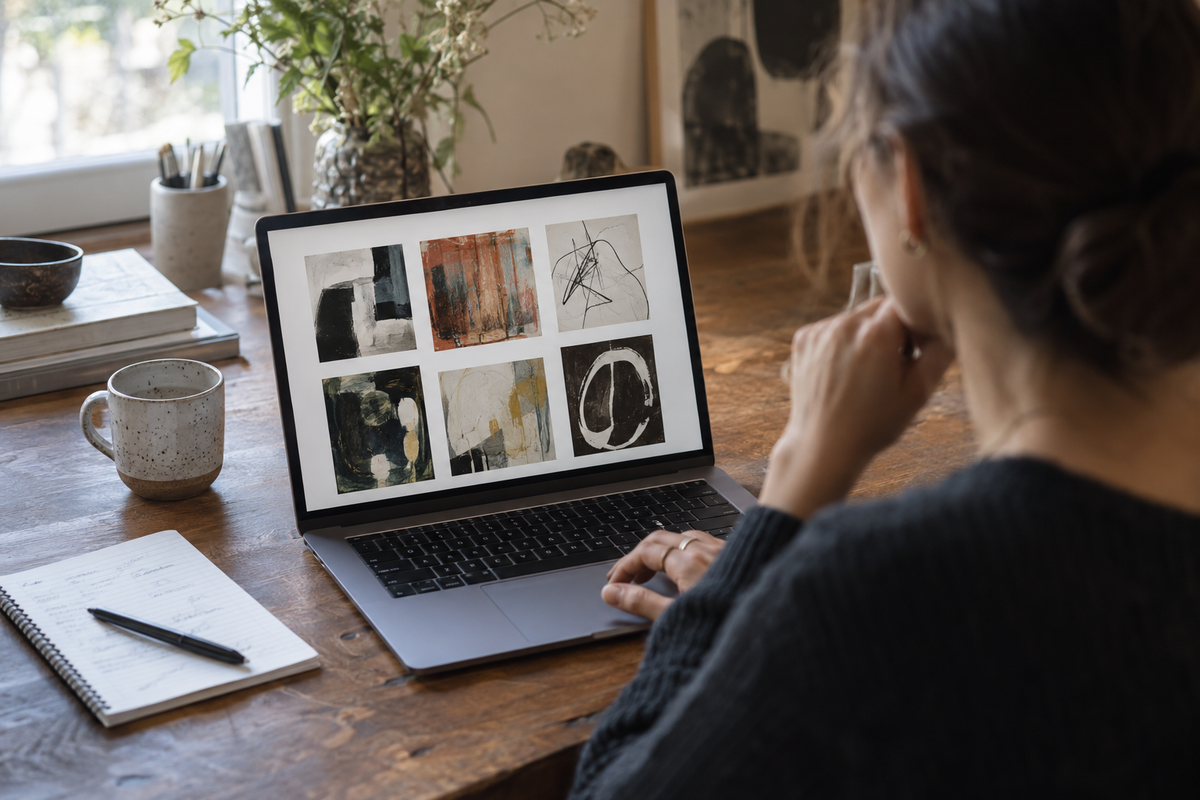
There is a persistent myth that galleries discover artists through a secret door: the right email, the right introduction, the right art-school pedigree or the right person at the right party.
Connections do matter in the art world, but the real process is usually less cinematic and much slower. Galleries notice artists through other artists, group exhibitions, studio visits, local scenes, curators, graduate programmes, art fairs, Instagram and years of repeated contact. The common factor is rarely a single moment. It is accumulated evidence.
For collectors, that process is useful to understand. A collector does not need to imitate a dealer, but galleries spend their professional lives deciding which practices deserve closer attention. Learning how they look can make your own search for emerging artists much sharper.
Galleries usually discover artists before they decide to represent them
Discovery and representation are not the same event.
A gallery may first see an artist in a group show, hear the name from another artist, notice an image online, encounter the work at a residency open studio and only months later arrange a studio visit. Even then, nothing may happen immediately.
In Artsy’s interviews with dealers about how galleries find new artists, several gallerists described discovery as an organic, community-based process. They emphasised artist networks, attending exhibitions and studio visits rather than relying on cold submissions. One dealer described the learning and courting process as a “slow burn”.
That idea is important for collectors too. Serious interest often builds through repetition: you see the work once, then again in a different context, then discover older work, then meet the artist or gallery. Each encounter either strengthens the practice or exposes its limits.
1. Other artists are one of the strongest discovery channels
Artists know who is actually working.
They share studios, install exhibitions together, visit one another’s shows, participate in residencies and talk constantly about what they are seeing. A gallery that trusts an artist may pay attention when that artist says, “You should visit this person’s studio.”
This is not simply nepotism. Peer recommendations can be valuable because they emerge from close observation of the work over time. Artists often see experiments, failures and development long before the public does.
What collectors can learn: when you discover an artist you respect, do not stop with that name. Look at who they exhibit with, whose work appears in their group shows, who shares their residency, and which artist-run spaces they support. One serious artist can become a map to an entire scene.

2. Group exhibitions tell galleries more than a polished portfolio
A portfolio shows what an artist wants you to see. A group exhibition shows how the work behaves in public.
Can it hold its own beside other practices? Does it need an elaborate explanation to function? Does the artist understand scale, installation and context? Does the work become more interesting when it enters a conversation with other artists?
Curated group exhibitions also reveal something about external judgement. Someone other than the artist has decided that the work belongs in a particular context.
What collectors can learn: search an artist’s exhibition history, then look at photographs from the shows. Do not only read the CV. See the actual room. Installation views are often more informative than a perfect isolated artwork photograph.

3. Studio visits are where interest becomes serious
A studio visit allows a gallery to see what Instagram and a fair booth cannot show: unfinished works, older series, failed experiments, material tests, the artist’s working rhythm and the connection between one body of work and the next.
This is why studio visits matter so much in gallery decision-making. Artsy’s dealer interviews describe them as a decisive part of understanding whether the work, process and artist-gallery relationship have real depth.
For collectors, direct studio access is not always possible, but the principle is transferable.
What collectors can learn: try to see more than the work currently for sale. Ask a gallery to show related works or previous series. Watch studio videos. Read interviews about process. If possible, visit an open studio. The goal is to understand whether the visible artwork is the surface of a deeper practice.

4. Galleries watch local scenes, not just global rankings
Before an artist becomes internationally visible, they are usually visible somewhere.
That “somewhere” might be a city, a university, an artist-run space, an island, a residency network or a cluster of independent galleries. Galleries often pay close attention to these smaller ecosystems because they reveal momentum before it becomes market consensus.
This is particularly relevant for collectors who assume that discovery requires travelling to London, New York, Paris or Basel. Major centres concentrate the market, but they do not have a monopoly on interesting work.
What collectors can learn: investigate regional scenes. Follow local curators, open studios, cultural institutions, emerging galleries and independent exhibitions. The advantage of a smaller scene is that you can often understand the relationships around an artist much more clearly.

5. Instagram can start the process, but rarely finishes it
Instagram matters because it can put an unfamiliar artist in front of a dealer instantly. Artsy’s gallery interviews include examples where an Instagram post was the initial spark for a later exhibition. But those same interviews make clear that a compelling feed usually leads to more research rather than an immediate representation decision.
That distinction is essential.
A strong social-media image proves that the work photographs well. It does not prove that the object is well made, that the artist has a coherent body of work, or that the practice can develop beyond one visual formula.
What collectors can learn: use social media to discover, then verify elsewhere. Search for exhibition views, older work, interviews, independent writing, gallery presentations and physical details.
6. Graduate shows and residencies create concentrated discovery
Graduate exhibitions, residency programmes and open studios allow galleries to see many developing practices in one place. Artsy’s collector guide to emerging art recommends graduate and MFA shows for the same reason: they are places where dealers themselves often look.
The value is not the diploma. It is concentration and timing. Artists are presenting a substantial body of work at a moment when their professional direction is still being formed.
What collectors can learn: do not treat a prestigious school as proof of artistic importance. Treat the exhibition as a discovery environment. Judge the work first; use the programme only as context.
7. Art fairs help galleries test attention outside their home market
For a younger gallery or artist, an art fair is not only a sales venue. It is a stress test.
The work is suddenly seen by collectors, curators, advisors, other galleries and institutions from different regions. Conversations happen quickly. Reactions can reveal whether the practice travels beyond its local context.
Sections dedicated to younger galleries or emerging presentations are particularly useful for discovery. Frieze, for example, regularly uses focused sections to bring newer galleries and artists into the same fair ecosystem as established programmes.
What collectors can learn: spend time in the emerging sections before the blue-chip booths. Ask galleries why they chose that particular artist for the fair. A thoughtful answer can tell you a great deal about the practice.
What galleries are really evaluating
Representation is a business decision, but good galleries are not simply asking, “Can we sell this?” They are also asking whether the relationship and practice can sustain years of development.
Typical questions include:
- Is there a distinct artistic language?
- Is the current body of work part of a larger trajectory?
- Can the artist continue developing without simply repeating a successful image?
- Does the work function physically, not only online?
- Can the artist produce consistently and professionally?
- Does the practice fit the gallery’s programme without duplicating another artist?
- Can the gallery contribute something meaningful to the artist’s development?
- Is there enough mutual trust for a long relationship?
These questions are far more useful to collectors than “How many followers does the artist have?”
What collectors should copy from gallery research
Follow the network, not only the name
If one artist interests you, identify the ecosystem around them: gallery, curator, group shows, residencies, peers and local institutions.
Look for repeated independent attention
One exhibition can happen for many reasons. Several meaningful appearances in different contexts are stronger evidence that the work continues to engage people outside the artist’s own promotion.
Compare old and new work
Galleries need to imagine the artist’s future. Collectors should do the same. Is there development? Are new questions entering the work? Is the artist taking risks?

See the object whenever possible
Surface, construction, scale and material can completely change your judgement. This is particularly true for painting and sculpture whose physical behaviour is central to the work.
Ask why this gallery cares
A useful question for a dealer is not “Will this artist become famous?” but “Why did you decide to work with this artist?” A serious gallery should be able to talk about the work in terms of ideas, development and context, not only demand.
Signals galleries notice that collectors often overlook
Consistency without sameness. An artist can make recognisably connected work without producing the same object repeatedly.
Material intelligence. The technique is not an effect added at the end; it shapes what the work means and how it behaves.
Curiosity. Artists who remain curious tend to generate new bodies of work rather than defend one successful formula forever.
Professional reliability. Deadlines, documentation, installation, communication and care for the work matter. A career is built partly through unglamorous competence.
Context. A serious artist usually understands at least part of the conversation their work enters — historically, materially or culturally.
What not to overvalue
Collectors sometimes mistake visibility for validation. Galleries know that the two are not identical.
- Follower count: useful for reach, weak as evidence of artistic depth.
- A long CV: quantity matters less than the quality and relevance of the contexts.
- One famous collector: interesting, but one purchase does not establish a trajectory.
- Pay-to-play awards: impressive wording can hide very little selection.
- Instant sell-outs: demand can be real, manufactured or temporary.
- A fashionable style: visual relevance is not the same as an individual language.
The “slow burn” is often a positive signal
Contemporary culture rewards sudden visibility, but gallery relationships are often built slowly for a reason. A dealer may watch an artist across multiple exhibitions before making a commitment. That period allows the work to prove that it can survive change.
Collectors can benefit from the same patience.
You do not have to buy the first time you discover someone. Follow the artist. Save several works. Revisit the practice after six months. If your interest deepens rather than disappears, that tells you something useful about both the work and your own taste.
Frieze’s 2026 programme for next-generation collectors similarly framed collecting around relationships with galleries and institutions and understanding cultural value beyond price. That is a healthier model than treating emerging art as a race to buy before somebody else does.
A practical discovery path for collectors
If you want to research new artists systematically, try this sequence:
- Choose three small or mid-size galleries whose programmes you genuinely like.
- Study their last five group exhibitions.
- Select two unfamiliar artists from each.
- Look at each artist’s older work and exhibition history.
- Identify the curators, residencies and artists connected to those shows.
- Follow those new nodes for a month.
- Visit the physical work when geography allows.
- Contact the gallery only after you know what specifically interests you.
This produces a much richer discovery network than searching “best emerging artists” once a year.
Where Olena Moloda fits into this conversation
Because this article is published by MOLODA ART GALLERY, our relationship to artist Olena Moloda is direct and should be stated clearly.
Her practice is relevant to the gallery-discovery framework because Moltenism is built around an artist-developed transparent painting medium rather than an externally applied style label. When evaluating an unfamiliar practice like this, the useful questions are the same ones a gallery might ask: Is there a coherent body of work? Does the medium create a real artistic language? Can that language develop across series and scales? Does the physical object offer something that the image cannot reproduce?
We explored Moloda alongside four other material-driven practices in 5 Emerging Contemporary Artists to Watch in 2026. For the broader context of new directions in art, see Five Emerging Art Movements Reshaping Contemporary Aesthetics.
The collector’s advantage is not privileged information — it is better attention
Most emerging artists are not hidden. Their work is already somewhere: in a small gallery, a group show, a studio, a residency, a regional exhibition or a social-media post that only a few hundred people noticed.
The difficult part is not access. It is learning what deserves a second look.
Galleries develop that ability through repetition, relationships and patient comparison. Collectors can do the same. Follow communities rather than rankings. Study development rather than follower counts. Look at objects, not only images. Ask galleries why they believe in an artist. And allow yourself enough time to distinguish an immediate visual effect from a practice you genuinely want to follow.
That is how new artists are usually discovered — not in one dramatic moment, but through a sequence of increasingly convincing encounters.
Further reading: Artsy — How Do Galleries Find New Artists? · Artsy — How to Collect Emerging Art · Frieze — Next Gen Collectors: How to Become an Insider in the Art World


Leave a comment
This site is protected by hCaptcha and the hCaptcha Privacy Policy and Terms of Service apply.