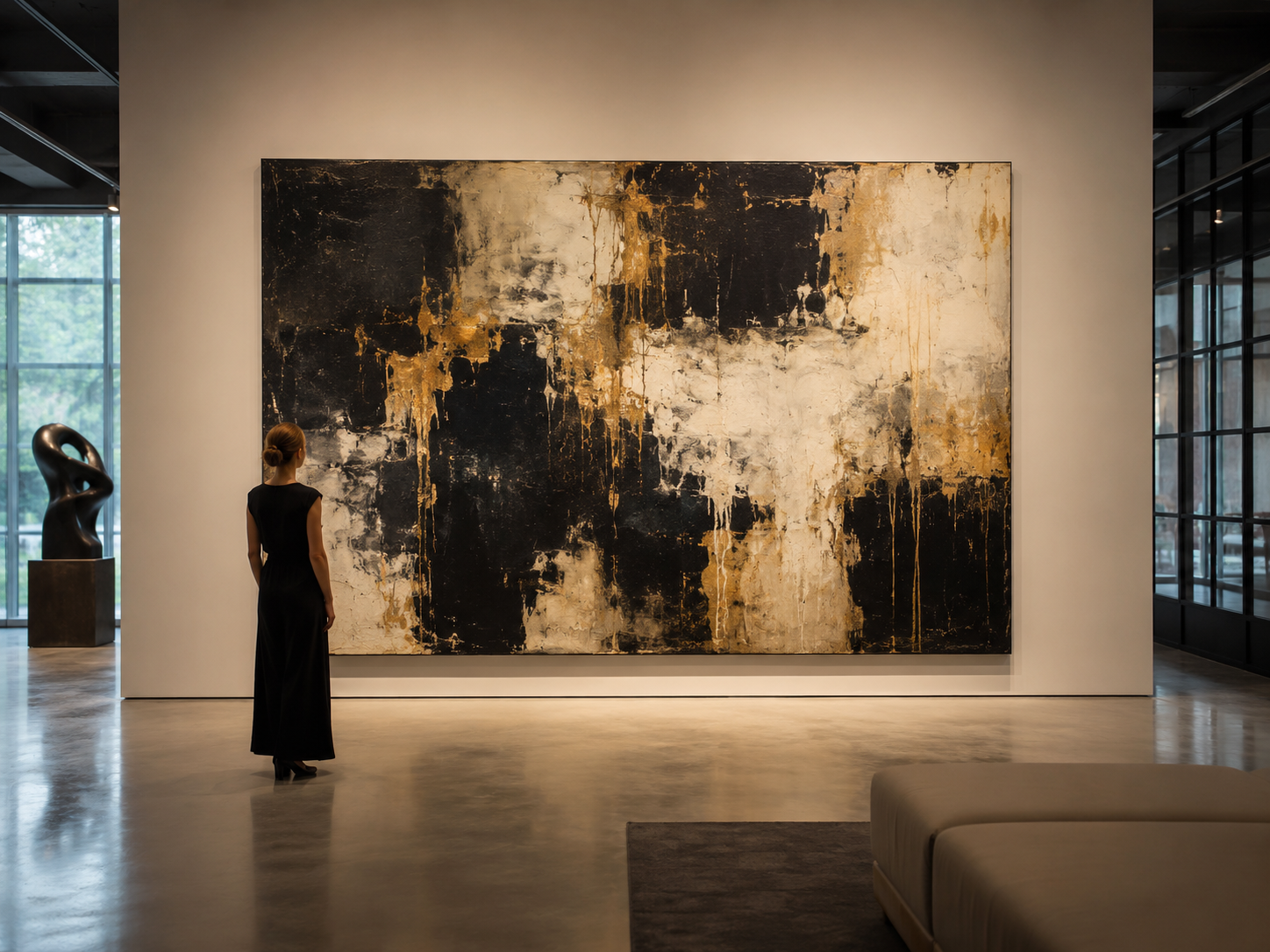
Contemporary art has a reputation problem. A canvas can be almost empty and cost more than a car. Another can look chaotic, unfinished or strangely simple and still end up in a serious collection. So how are you supposed to know whether you are looking at something genuinely strong—or simply something that has been marketed well?
There is no universal formula for deciding whether art is “good.” Taste changes, movements change, and some works need time before they make sense. But that does not mean every judgment is arbitrary. There are practical things you can look for that go far beyond whether you personally find a painting beautiful.
Here are seven of the most useful.
1. The work has its own internal logic
Strong art usually feels like it obeys a set of rules, even when those rules are invisible.
Look at the composition, scale, color, repetition, empty space, texture and rhythm. Do the parts feel connected? Does the work seem to know what it is doing? Or does it feel like a collection of unrelated decisions?
This is especially important in abstract art. A painting does not need to depict a recognizable subject to feel coherent. In fact, one of the clearest differences between a random surface and a convincing abstract work is that the convincing one creates a visual system of its own.
2. The choices feel necessary, not decorative
Decoration is not a bad thing. Beauty, color and atmosphere matter. But memorable art usually contains choices that feel more specific than “this looks nice.”
Ask yourself what would happen if one major element were removed. Would the work lose tension, balance or meaning? If the answer is yes, that element is probably doing real work inside the composition.
Good contemporary art often has a sense of inevitability: after you spend time with it, the decisions begin to feel as though they could not have been made in quite another way.
3. The material is part of the idea
Technique alone does not make art important. A technically difficult painting can still be forgettable. But in strong work, the material usually contributes to the meaning and personality of the piece.
Paint can be thin, heavy, polished, raw, transparent, cracked, layered, poured or scraped. Each approach creates a different visual experience.
In Moltenism, for example, the behavior of the painting medium is part of the visual language itself. Transparent layers, glossy surfaces, raised lines, pools of color and controlled movement are not simply effects added at the end; they shape the identity of the work from the beginning.
The same principle applies across contemporary art: material becomes convincing when it feels inseparable from the artist’s intention.

4. It survives the second look
Some artworks are impressive for ten seconds and empty after ten minutes. Others reveal themselves slowly.
A useful test is simple: after the initial reaction, is there still something left to discover?
Strong work often changes as you move closer, step back, see it in different light or return to it another day. New relationships appear between colors, forms and textures. Something you ignored on the first look suddenly becomes important.
This “second-look value” matters even more when buying art for your home. A work that will live with you for years should ideally offer more than an immediate visual hit.

5. It creates tension, not just prettiness
Many people assume that good art should be beautiful. It can be—but beauty is only one tool.
Some of the most engaging works contain contradiction: calm colors with aggressive marks, delicate surfaces with heavy forms, symmetry interrupted by something unstable, or elegance mixed with discomfort.
That friction keeps the eye active.
This also explains why some contemporary art initially feels awkward or even ugly. If that question interests you, read Why modern art can look so ugly—and why that is not accidental.
6. It feels specific to one artist
Originality does not mean creating something with no historical influences. That is almost impossible. Artists absorb movements, materials, architecture, fashion, technology, landscape and other artists.
What matters is whether those influences are transformed into a language that feels personal.
When you see several works by the same artist, can you recognize a consistent way of thinking? Are there recurring decisions, tensions, materials or visual structures? Does the work feel authored?
This is one reason collectors often look beyond a single attractive painting and study a body of work. Consistency across multiple pieces can reveal whether an artist is developing a real visual language rather than repeating a trend.
7. It can stand without a long explanation
Context can deepen art. A title, an artist statement or the history of a movement can completely change the way we understand a piece.
But the artwork should still do something before the explanation arrives.
If a work becomes interesting only after reading several paragraphs about what it is supposed to mean, that does not automatically make it bad—but it is worth noticing. Visual art communicates visually first.
A strong painting may become richer with explanation, yet it already has presence, tension, atmosphere or curiosity on its own.
What does not automatically make art good?
Several things are often confused with quality:
- Realism. The ability to paint something accurately is a skill, not a guarantee of artistic importance.
- Complexity. More detail does not automatically mean more depth.
- Price. Market value and artistic quality overlap sometimes, but they are not the same thing.
- Fame. Recognition can come from strong work, but reputation can also amplify weak work.
- Shock. Provocation is useful only when it serves something beyond attention.
- Beauty. A beautiful work can be excellent, but beauty alone is not proof of depth.
A better question than “Is this art good?”
When you are standing in front of a painting—or thinking about buying one—try replacing the question “Is this good?” with a few more specific ones:
- Does this work have a clear visual identity?
- Does it feel replaceable, or could only this artist have made it this way?
- Do I notice more after looking for a while?
- Would I still want to see it every day after the novelty disappears?
- Does it change the atmosphere of the room?
Those questions are often much more useful than trying to reach an abstract verdict about quality.
Contemporary art is easier to read once you know what to look for
The gap between “I could do that” and “I understand why this works” is often simply the gap between looking quickly and looking carefully.
Contemporary art does not always reward the same skills as traditional painting. Sometimes the decisive factor is not virtuoso drawing, but originality, material intelligence, composition, restraint, tension or the creation of a new visual language.
And that is precisely why the field keeps changing. If you are interested in where it may be going next, explore Five Emerging Art Movements Reshaping Contemporary Aesthetics.
Or browse our available original artworks and test these seven ideas for yourself.


Leave a comment
This site is protected by hCaptcha and the hCaptcha Privacy Policy and Terms of Service apply.