In 2019, visitors to Art Basel Miami Beach found a banana duct-taped to a wall at the booth of Perrotin gallery. Maurizio Cattelan called the work Comedian. Editions initially sold for around $120,000, with the price reportedly rising to $150,000 for the final edition.
Five years later, in November 2024, another edition of Comedian was offered at Sotheby’s in New York. The estimate was $1–1.5 million. It sold for $6.24 million.
The banana had not become rarer. Bananas had not become difficult to manufacture. The cost of duct tape had not increased by several thousand percent.
So what, exactly, became more valuable?
That question leads directly into one of the strangest economic systems in the world: the contemporary art market.
Unlike gold, a square metre of property or a publicly traded share, an artwork has no standard unit price. Two canvases of the same dimensions, made with the same paint and requiring the same number of hours, can be worth €500 and €50 million. One artist can sell a work for €2,000 while another sells something visually simpler for €2 million.
To understand why, we have to stop thinking of art prices as the cost of an object and start thinking of them as the price of a position inside a cultural system.
A $59.6 billion market built on objects with no standard price
According to the Art Basel and UBS Global Art Market Report 2026, global art sales reached an estimated $59.6 billion in 2025. Dealer sales accounted for about $34.8 billion, while public auction sales reached approximately $20.7 billion. The United States alone represented 44% of global sales by value.
That is a serious global industry. Yet the product at its centre is unusually difficult to price.
A house can be compared with nearby houses. A company can be examined through revenue, cash flow and assets. A diamond has measurable characteristics. A litre of oil is interchangeable with another litre of the same grade.
An original artwork is the opposite. Ideally, it is not interchangeable at all.
This is the first clue.
The first misconception: you are not paying for paint and canvas
People often react to an expensive painting by asking: “But how much did it cost to make?”
For art, this question has very little connection to market value.
The raw materials establish a practical minimum below which producing the work may make little sense, but they do not determine what collectors will pay. The same is true in many creative industries. The paper inside a rare first-edition book is not what makes the book valuable. The metal in a historic watch is not the reason collectors fight over it. The cost of recording a famous song tells you almost nothing about the value of the rights to that song.
Art is primarily an authorship market.
You are buying an object—or sometimes an authenticated concept—connected to one specific artist, one moment in that artist’s career, and one place in a larger cultural history.
This is why “I could make that” and “I could own that” are completely different statements.
So what actually creates the price?
There is no single formula, but seven forces appear again and again.
1. The artist’s market history
Collectors do not evaluate every painting from zero. They look at the artist’s existing market.
What have similar works sold for? Which galleries represent the artist? Which collectors already own the work? Has the artist exhibited internationally? Are works held by museums? Is there a consistent secondary market? Have previous prices risen, fallen or remained stable?
The stronger and more documented that history becomes, the less the buyer feels that the price is completely arbitrary.
This does not prove artistic quality. It creates market confidence.
2. Scarcity
An artist can become famous and still damage prices by releasing too much similar work too quickly.
Scarcity matters because collectors need to believe that the object they are buying cannot simply be replaced tomorrow by fifty nearly identical works.
This is one reason a disciplined body of work can be more valuable than uncontrolled production. The market is constantly judging not only demand, but the relationship between demand and supply.
3. Provenance
Provenance is the ownership history of an artwork.
A painting that has belonged to a celebrated collection, appeared in an important exhibition or been documented for decades carries something more than pigment: it carries a biography.
In the high-end market, that biography can materially affect price. A work with impeccable provenance may be easier to authenticate, easier to insure, easier to resell and more attractive to institutions and collectors.
Sometimes the former owner becomes part of the artwork’s story.
4. The gallery and institutional ecosystem
A serious gallery does more than hang paintings on a wall and take a commission.
At its best, a gallery builds an artist’s market over years: placing works carefully, organizing exhibitions, documenting the practice, communicating with museums and curators, producing catalogues, controlling price consistency and preventing important works from being dumped onto the market.
Museum exhibitions and institutional collections can add another layer of validation. Again, none of this mathematically proves that an artwork is good. But it changes how the market perceives risk, importance and longevity.

5. The work’s position inside the artist’s career
Not every painting by a famous artist is equally valuable.
Collectors often pay premiums for works from periods considered decisive: the year an artist developed a recognisable language, a historically important series, a rare subject, an unusually large format, or a work connected to a major exhibition.
A mediocre example by a famous artist may sell for far less than a museum-quality work by the same person.
6. Recognisability and cultural memory
Some artworks escape the art world and become symbols.
Warhol’s Marilyn. Banksy’s balloon girl. Hockney’s swimming pools. Basquiat’s heads. Koons’s reflective sculptures.
Once an image becomes culturally recognisable, buyers are no longer competing only for an artwork. They are competing for a piece of a story that millions of people already know.
7. Competition at the exact moment of sale
This is the factor that can turn an already expensive artwork into an apparently irrational one.
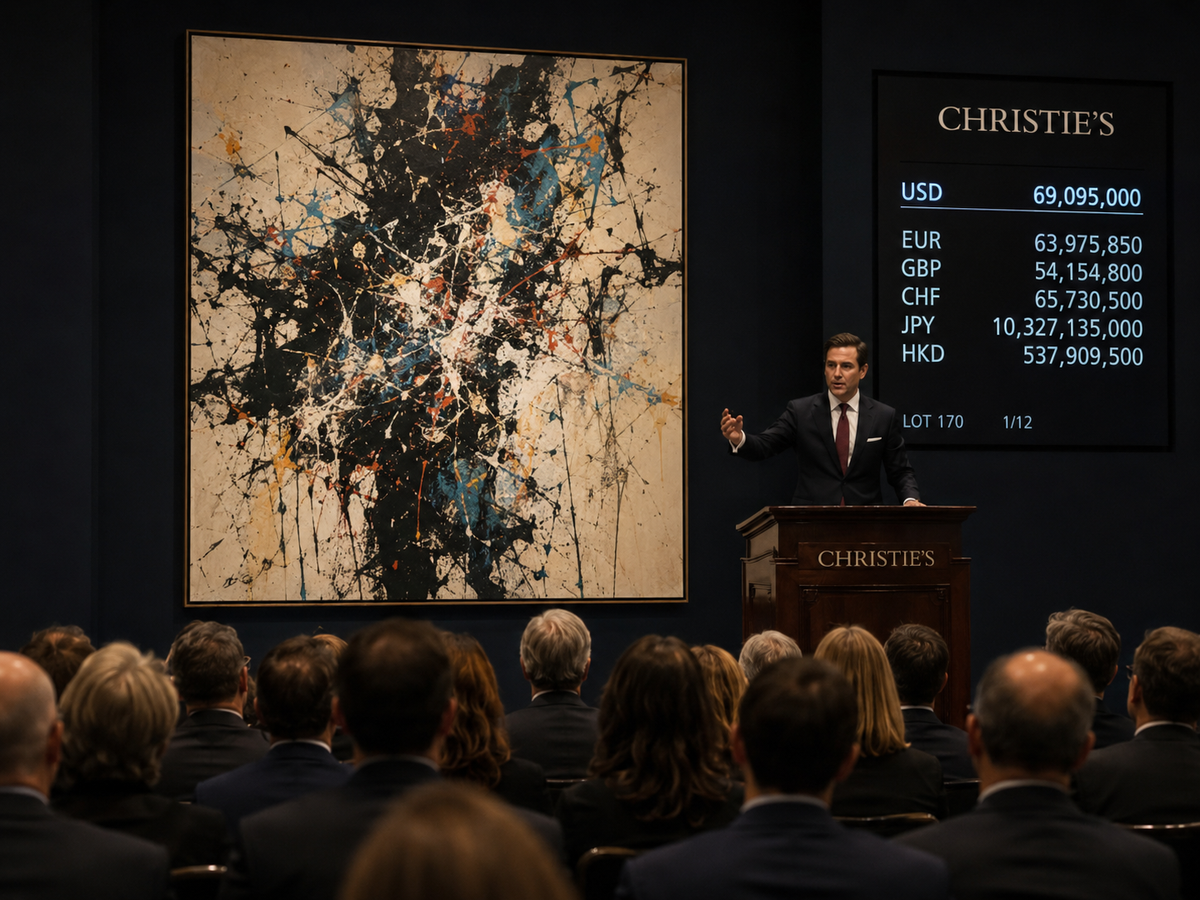
At auction, you do not need a thousand people willing to pay $50 million. Sometimes you need only two people who refuse to lose.
The final price is not a universal scientific valuation. It is the point at which the second-most determined bidder stops.

Case file #1: the banana that went from $120,000 to $6.24 million
Cattelan’s Comedian may be the clearest modern demonstration of how art pricing works because the physical material is so obviously insignificant.
When the work appeared at Art Basel Miami Beach in 2019, The Art Newspaper reported a price of $120,000. It immediately became a worldwide argument about value, absurdity and the art market.
That argument was not a side effect of the artwork. It became part of the artwork.
By the time Sotheby’s offered an edition in 2024, Comedian had accumulated five years of headlines, memes, criticism, museum attention and art-historical debate. Sotheby’s estimated it at $1–1.5 million. The final sale price was $6.24 million.
What increased in value was not the fruit. It was the work’s cultural footprint.
This is why conceptual art is so useful for understanding the market: it removes the comforting illusion that expensive art must contain expensive materials.
Case file #2: Banksy and the artwork that became more valuable by destroying itself
In October 2018, Banksy’s Girl with Balloon sold at Sotheby’s London for £1,042,000.
Seconds after the hammer fell, a shredder hidden inside the frame activated and pulled the canvas through it. The mechanism stopped partway, leaving the lower portion hanging in strips.
The event became global news. The damaged object was authenticated as a new artwork: Love is in the Bin.
Three years later, the transformed work returned to the same auction house. After a ten-minute contest involving nine bidders, it sold for £18,582,000.
Think about what happened economically.
The physical object had been damaged. Under normal commodity logic, damage should reduce value. But the damage created an unprecedented history. The object was no longer simply one Banksy image among others. It had become the physical evidence of one of the most famous auction events of the century.
The “defect” became provenance.
Case file #3: Beeple and the $69.3 million digital file
In March 2021, Christie’s sold Beeple’s EVERYDAYS: THE FIRST 5000 DAYS, a purely digital work linked to an NFT, for $69,346,250.
The auction had started at $100.
Christie’s described the result as a watershed moment for digital art. At the time, it made Beeple one of the most expensive living artists ever sold at auction.
Again, production cost cannot explain the price. Nor can physical scarcity in the traditional sense, because a digital image can be copied perfectly.
The scarcity was created through authenticated ownership, while the extraordinary price was amplified by timing: NFT enthusiasm, cryptocurrency wealth, global press attention, Christie’s institutional legitimacy and competition for a work that could be presented as a historical first.
Whether that price proves lasting value is a different question. But it demonstrates something essential: art markets can create scarcity around ownership even when visual access to an image is unlimited.
Case file #4: Damien Hirst bypasses the galleries
In September 2008, Damien Hirst did something highly unusual for a major living artist. Rather than release a new body of work through his long-standing galleries, he sent an entire show directly to Sotheby’s.
The two-day auction, Beautiful Inside My Head Forever, raised approximately £111 million ($198 million at the time), then a record for a single-artist auction. The Golden Calf, a bull preserved in formaldehyde with 18-carat gold horns and hooves, sold for £10.3 million.
Sotheby’s later described the sale as a landmark example of an artist taking work directly to market.
The remarkable part is not only the total. The sale showed that distribution itself is part of art pricing.
Where a work is sold, how it is introduced, who controls supply and whether the sale feels like a cultural event can materially affect demand.
What does $90 million—or $195 million—actually buy?
At the top of the market, prices become so large that they stop feeling real. A few documented auction results help put the scale in perspective.
| Artwork | Artist | Year sold | Reported sale price |
|---|---|---|---|
| Shot Sage Blue Marilyn | Andy Warhol | 2022 | $195,040,000 |
| Untitled (1982) | Jean-Michel Basquiat | 2017 | $110,500,000 |
| Rabbit | Jeff Koons | 2019 | $91,075,000 |
| Portrait of an Artist (Pool with Two Figures) | David Hockney | 2018 | $90,312,500 |
| EVERYDAYS: THE FIRST 5000 DAYS | Beeple | 2021 | $69,346,250 |
| Comedian | Maurizio Cattelan | 2024 | $6,240,000 |
These numbers come from major auction houses and are not estimates: they are reported sale results. Christie’s recorded Koons’s Rabbit at $91.075 million, Hockney’s pool painting at $90.3125 million, and Warhol’s Marilyn at $195.04 million. Sotheby’s recorded Basquiat’s 1982 Untitled at $110.5 million.
But the table hides a crucial detail: a public auction result is only the visible tip of the market.
The primary market and secondary market are two different worlds
The primary market is where a work is sold for the first time, usually by the artist or a gallery representing the artist.
The secondary market begins when an owner resells the work, often through another gallery, an art dealer or an auction house.
This distinction matters enormously.
A gallery may deliberately keep an emerging artist’s primary prices relatively stable. The objective is often to build a collector base and avoid an artificial spike that the artist cannot sustain.
At auction, by contrast, a work may be exposed to open competition. If two wealthy buyers want the same object, the price can move far beyond the level at which the artist originally sold it.
That creates a strange situation: an artist may sell a work for €10,000, and years later the same work might resell for €100,000 or €1 million. The artist does not simply receive that increase; the resale proceeds normally belong to the seller, although artist resale-right royalty systems apply in some jurisdictions.
So an artist’s “market value” and an artist’s actual income are not the same thing.
Why galleries sometimes refuse to sell to someone who can pay
This seems absurd until you understand market-building.
For highly sought-after artists, some galleries care about where the painting will go. A collector known for immediately reselling works can be less desirable than a collector who keeps them, lends them to exhibitions or eventually donates to a museum.
The reason is price stability.
If too many works appear at auction too quickly, the artist can begin to look speculative. Worse, if a work fails to sell, the public failure becomes a new market reference.
Scarcity in contemporary art is therefore not always accidental. Sometimes it is actively managed.
The auction price you read in the newspaper is not always the hammer price
This is an important detail that many people outside the art market miss.
At major auction houses, the winning bid is called the hammer price. The buyer usually also pays a buyer’s premium to the auction house on top of that amount, plus any applicable taxes and other charges.
Christie’s explains that the total cost to a buyer can consist of the hammer price, buyer’s premium and applicable additional charges.
Many headline auction results are reported as prices including buyer’s premium.
So when you read that a work “sold for $91 million,” that number does not necessarily mean the seller received $91 million.
Estimates are not objective valuations either
Before an auction, specialists normally publish a low and high estimate.
That range is informed by factors such as the artist’s comparable sales, rarity, date, size, medium, provenance, condition, subject and current demand.
But an estimate also has a strategic role. Too high, and bidders may stay away. Too low, and the estimate can generate excitement and encourage participation.
There is also usually a reserve: a confidential minimum below which the seller does not agree to sell.
This means the public number you see before the auction is not a pure scientific prediction. It is part valuation, part market positioning.
And then there are guarantees
At the highest end of the market, the mechanics become even more interesting.
An auction house may give a seller a minimum price guarantee: certainty that the seller will receive at least an agreed amount even if bidding disappoints.
The auction house may then share that risk with a third party. In a third-party guarantee or irrevocable-bid arrangement, another party commits before the auction to bid at an agreed level. If nobody bids higher, that party can become the buyer.
Christie’s publicly explains these arrangements and marks affected lots with catalogue symbols.
This does not mean the auction result is fake. The guarantor is taking real financial risk and may end up owning the work. But it does show that a glamorous auction evening may begin with part of the financial risk already engineered in advance.
At the multimillion-dollar level, the art auction is not simply a room full of people spontaneously raising paddles. It can be a sophisticated financial transaction with pre-sale negotiations, guarantees, reserves, fees and risk-sharing.
Is the contemporary art market manipulated?
This is where discussions usually become simplistic.
One side says the whole market is a scam. The other treats every auction record as proof of artistic greatness.
Neither explanation is useful.
The art market does have characteristics that make price discovery unusually opaque:
- Every major object is unique or scarce.
- Many private-sale prices are confidential.
- A relatively small number of collectors can influence demand at the top.
- Galleries actively manage supply and placement.
- Auction estimates are strategic as well as analytical.
- Reputation can become self-reinforcing.
- Information is distributed unevenly between insiders and new buyers.
That creates room for speculation, fashion, status signalling and occasionally poor decisions.
But there is another side. Expensive artworks also fail to sell. Artist markets fall. Collectors lose money. Famous names go through long periods of declining demand. Guarantees exist precisely because auction houses and sellers know that a high estimate does not magically create a buyer.
A price can be socially constructed and still be economically real.
Does expensive art mean good art?
No.
Price measures what a particular market is willing to pay for ownership at a particular moment. It can reflect artistic importance, but it also reflects scarcity, wealth, fashion, historical status, provenance, institutional validation, access and competition.
A brilliant painting by an unknown artist can cost €1,000. A weak work by a famous artist can cost hundreds of thousands because the signature itself has a market.
This is why artistic judgment and market judgment should never be treated as identical.
We explored that distinction in more detail in How to Tell If Contemporary Art Is Actually Good: 7 Things to Look For.
Why, then, do collectors pay enormous prices?
Because art can satisfy several motives at once.
A collector may genuinely love the work. They may want to support an artist. They may be building an historically coherent collection. They may enjoy competition. They may want social recognition. They may see art as a store of wealth. They may hope the work appreciates. They may want something no one else can have.
The motivations can be aesthetic, intellectual, emotional, social and financial simultaneously.
That combination is what makes art different from most luxury products.
A luxury car is expensive, but another can be manufactured. A one-of-one painting by a deceased artist cannot.

What makes an emerging artist’s prices grow?
For artists who are not yet global names, sustainable price growth tends to be much less dramatic than auction headlines suggest.
Healthy development often comes from a combination of:
- a recognisable and evolving artistic language;
- a coherent body of work rather than isolated successful pieces;
- consistent pricing across galleries and markets;
- serious documentation and provenance;
- repeat collectors rather than one viral sale;
- exhibitions and critical attention;
- careful control of supply;
- works entering respected private or institutional collections;
- enough time for a real market to form.
A sudden auction spike can create attention. It can also create a dangerous benchmark that the artist’s next works cannot support.
In other words, the highest possible price today is not always the best strategy for an artist’s career tomorrow.
If you are buying art, what should you actually check?
You do not need to think like an auction-house specialist to make a sensible purchase.
For an original artwork, ask:
- Would I still want this if nobody told me it was a good investment?
- Does the artist have a coherent body of work? One impressive image is different from years of serious practice.
- Is the price consistent? Similar works by the same artist should have a comprehensible relationship in price.
- Is the work properly documented? Invoice, provenance and authenticity information matter.
- Is it truly original? Understand whether you are buying a unique work, edition or reproduction.
- What is the condition? Especially for older or technically complex work.
- Who are you buying from? A direct relationship with the artist or reputable gallery makes future documentation much easier.
- Can you afford to assume the resale value will be zero? Unless you are an experienced collector, this is a much safer mindset than buying on promises of appreciation.
The uncomfortable conclusion: art prices are real, but they are not natural laws
The most expensive contemporary artworks are not priced according to the quantity of paint, the number of hours worked or an objective measurement of beauty.
Their prices emerge from a network: artist, work, gallery, collector, museum, critic, auction house, provenance, scarcity, publicity and competition.
Sometimes that network recognises a genuinely transformative artist. Sometimes it gets carried away. Often it does both at the same time.
Maurizio Cattelan’s banana is almost a perfect diagram of the system. A cheap, replaceable object became the centre of a multimillion-dollar transaction because the physical banana was never really the scarce thing.
The scarce thing was authorship, authentication, history and the right to own a famous cultural event.
That may sound absurd. But once you understand it, much of the contemporary art market stops looking mysterious.
It starts looking like what it actually is: a market for objects, ideas, reputations and stories—where the final price is the number attached to that story at one particular moment.
Further reading and sources
- Art Basel & UBS Global Art Market Report 2026
- Sotheby’s — Maurizio Cattelan, Comedian
- Sotheby’s — Banksy, Love is in the Bin
- Christie’s — Beeple, EVERYDAYS auction result
- Christie’s — Andy Warhol, Shot Sage Blue Marilyn
- Christie’s — Understanding auction fees
- Christie’s — Financial arrangements and auction guarantees
If you are interested in where contemporary art may be heading next, continue with Five Emerging Art Movements Reshaping Contemporary Aesthetics, or explore available original artworks at MOLODA ART GALLERY.


Leave a comment
This site is protected by hCaptcha and the hCaptcha Privacy Policy and Terms of Service apply.